
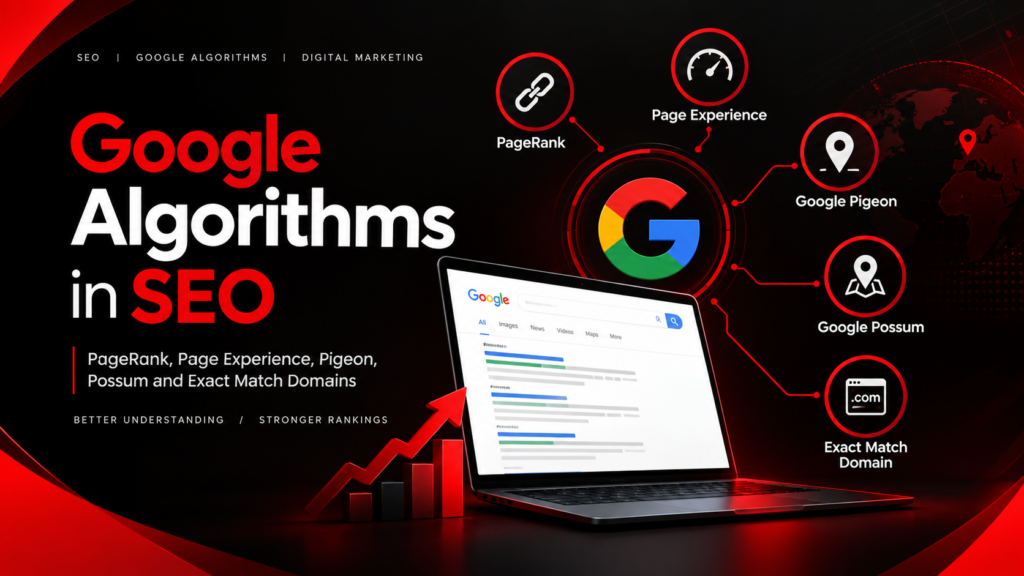
PageRank, Page Experience, Pigeon, Possum, and Exact Match Domains are Google algorithms used in SEO.
Introduction
Google algorithms play an important role in search engine optimization (SEO). They help Google discover, understand, and rank web pages according to their relevance and usefulness. For digital marketers, understanding these systems is essential for improving website visibility and attracting organic traffic. PageRank, Page Experience, Google Pigeon, Google Possum, and Exact Match Domains are important SEO concepts that explain different aspects of Google’s search systems. Learning about them helps businesses develop effective SEO strategies and improve their online presence.
1. What Is the Google Algorithm?
The methods Google employs to arrange and prioritize data in search results are referred to as the Google algorithm. These systems consider various factors, including content relevance, page quality, links, search intent, and website usability.
For example, when someone searches for “digital marketer in Kannur,” Google tries to show relevant websites and local businesses that match the search. Creating useful content, optimizing website pages, and maintaining accurate business information can help improve search visibility.
Google regularly updates its search systems to provide more relevant results. Therefore, digital marketers should focus on helpful content and ethical SEO practices rather than trying to manipulate rankings.
2. What Is PageRank in SEO?
PageRank is one of Google’s original link-analysis systems. It evaluates the relationships between web pages by examining links pointing to them. A link can serve as a suggestion, assisting search engines in determining the significance of a page.
For instance, a link to an educational SEO article from a respectable marketing website may increase the piece’s authority. However, not all links have equal value, and relevance and quality matter.
To support PageRank-related SEO efforts, website owners should create valuable content, earn genuine backlinks, and use internal links to connect related pages. They should avoid manipulative link-building practices.
PageRank remains part of Google’s core ranking systems, but it is only one component of a much broader process. High-quality content, relevance, and user satisfaction are also important for successful SEO.
3. What Is the Google Page Experience System?
Aspects of how users interact with a website are referred to as page experience. A useful website should also be easy to navigate, secure, mobile-friendly, and responsive.
Core Web Vitals measure important aspects of user experience, including loading performance, responsiveness, and visual stability. Slow loading times and unexpected layout changes can frustrate visitors and reduce engagement.
Website owners can improve page experience by compressing images, optimizing website code, using HTTPS, improving mobile usability, and creating clear navigation. These improvements make websites easier to use.
However, Page Experience is not a single ranking score that guarantees higher positions. Google considers several signals together, and helpful, relevant content remains essential for long-term SEO success.
4. What Is Google Pigeon?
2014 saw the release of Google Pigeon, a local search update. Its goal was to enhance the connection between local search results and Google’s standard search results.
This update highlighted the importance of location relevance for businesses targeting customers in specific areas. For example, a person searching for “SEO services in Kannur” expects results relevant to that location.
Businesses can strengthen their local SEO by maintaining an accurate Google Business Profile, creating location-specific website content, collecting genuine customer reviews, and keeping business information consistent across online directories.
Pigeon is a historical algorithm update rather than a separate modern ranking system. Nevertheless, its impact demonstrates why local relevance remains important for businesses seeking customers through Google Search.
5. What Is Google Possum?
Google Possum is the name commonly given to a local search update introduced in 2016. It influenced how local business listings appeared in search results, particularly regarding the searcher’s location and the filtering of similar listings.
For example, two businesses operating from the same building might not always appear together in every local search. Search results may also vary depending on the searcher’s location.
Businesses can support local visibility by providing accurate addresses, choosing appropriate business categories, maintaining updated listings, and clearly describing their services.
Possum is another historically significant local search update. Modern local SEO requires businesses to focus on accurate information, relevant services, and genuine customer value rather than optimizing for one specific historical update.
6. What Is an Exact Match Domain?
An Exact Match Domain (EMD) is a website domain that closely matches a search keyword or phrase. For example, a domain containing the words “best digital marketing services” is an exact-match-style domain for related searches.
In the past, some website owners used keyword-rich domains to try to improve their search rankings. Google’s Exact Match Domain system was introduced to reduce the ranking advantage of low-quality websites that relied heavily on keyword-matching domain names.
However, keyword-rich domains are not automatically penalized. A relevant domain can still support branding, but its name alone cannot guarantee better rankings.
For effective SEO, choose a memorable domain, publish original content, optimize page titles naturally, and create a useful website structure. Building a recognizable brand is more valuable than relying only on domain keywords.
Conclusion
Successful search engine optimization requires an understanding of Google algorithms. PageRank explains the role of links, Page Experience highlights website usability, Pigeon and Possum demonstrate the evolution of local search, and Exact Match Domains show why keywords in domain names cannot guarantee rankings.
Digital marketers should combine technical SEO, quality content, ethical link building, and local optimization to improve website visibility. Rather than chasing individual algorithm updates, businesses should focus on creating useful experiences that meet their audience’s needs. This This strategy offers a more solid basis for long-term success in digital marketing and sustainable organic traffic.